“The bad news is that while drunk driving has decreased, drugged driving has increased.”
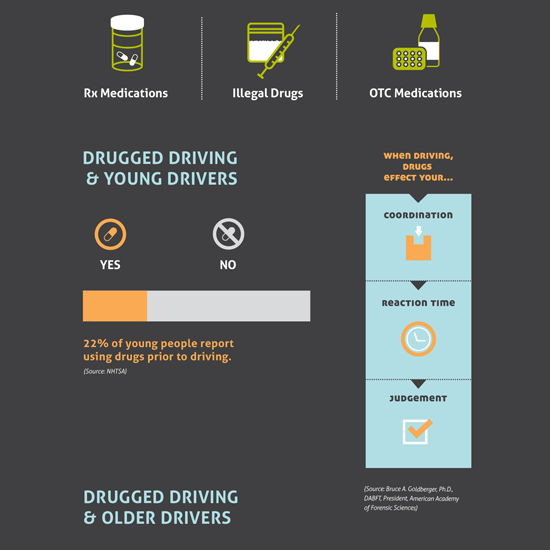
How dangerous is drugged driving? Very! It doesn’t matter if it is legal or illegal substances, drugged driving is becoming an increasing problem. Over a five-year period there were 127,461 fatal crashes in the United States; at least 15.8% of them involved a drugged driver. Of course, the percentage is probably much higher but we don’t test in one-third of the crashes.
The Institute of Behavior and Health estimates 580,000 injuries are directly attributable to drugged driving each year. The National Highway Traffic Safety Administration’s Fatality Analysis Reporting System (FARS), a census of fatal motor vehicle traffic crashes, provides data on the presence of drugs among drivers. Of the 12,055 drivers with known test results in 2009, 33% were positive for drugs. Frightening. Even more scary is that according to the 2008 National Survey on Drug Use and Health, an estimated 10 million people aged 12 and older reported driving under the influence of illicit drugs during the year prior to being surveyed.”
(Substance Abuse and Mental Health Services Administration. 2008 National Survey on Drug Use and Health. Rockville, MD: Office of Applied Studies, 2009.)
We need to act now to stop this carnage on our highways!
Click here for more Impaired Driving Policies & Legislative recommendations.
Click to view full Infographic
Logo designed by Mary Dorthy Fain
Website designed and developed by
Tseday Gebrehiwot, Robert Gu, Giulia Marconi & Sally Traynham through Boston University Center for Digital Imaging Arts
© 2026 We Save Lives | 1648 Taylor Road #484 Port Orange, Fl 32128
We Save Lives is a 501 C3 pending IRS exemption.


